Combining the months, as it took me a while to finish the first two books. Summer seems to be at the front door, but no light reading so far.
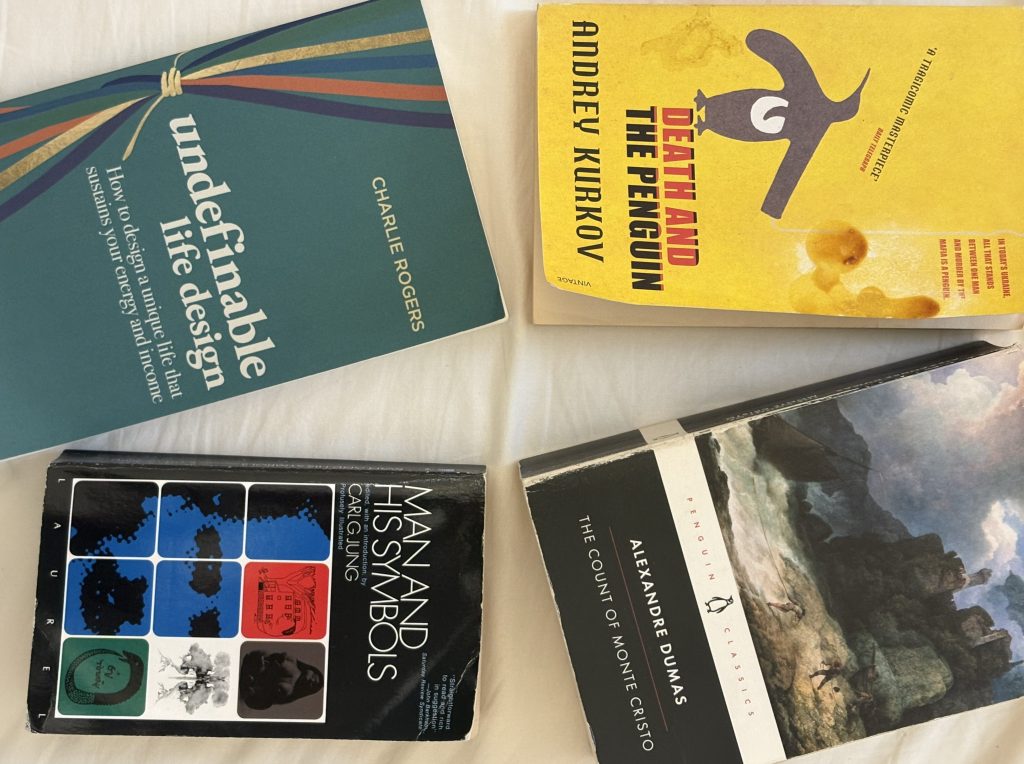
Man and His Symbols – Carl Jung
This was an interesting, even if at times repetitive, read. The central idea, that dreams are symbolic expressions of the unconscious, is nothing new to most readers today, but the book is probably one of the works that helped popularize this idea for a wider audience. Worth mentioning, Jung only wrote the first chapter; the rest are each written by a different colleague.
I say that it is repetitive because the same analyses and themes run across various pages at many different times in the book. But, still, I liked the book. It went deeper into something I believe to hold truth. I often experience dreams at different times in my life that seem to symbolize something happening. Now, I don’t believe this to be an exact science: the examples in the book itself could sometimes be interpreted differently, and I was also left thinking about the dreams the patient did not remember – do we just ignore those?
One chapter I really liked was “Symbolism in the Visual Arts” by Aniela Jaffé. It is worth reading, even if just as a stand-alone work.
In general, I take this book with a pinch of salt, but I have to say it made me more aware of my dreams and the potential warnings they might be giving me.
The Count of Monte Cristo – Alexandre Dumas
Yes, yes, yes! What a fantastic piece of work. I had this book on my shelf for a while but was afraid to pick it up because of its size. But am I happy I did. This does not feel like a long book, just because of what a page-turner it is.
Once I started the book, I was looking forward every day to sitting down for some time with my new friend the Count and living his adventures with him. It is so well written, both in style and in content. The story is always moving, always surprising, always creating expectation. The descriptions make one imagine the places and people vividly in front of oneself.
There are, of course, philosophical elements to it: revenge, justice, time, forgiveness… and there is a healthy amount of wisdom in the book. I’ve taken many notes and quotes. But, honestly, this stands out to me because of the amazing read it is. I had a fantastic time reading this book, and it goes directly into my all-time favorites.
Undefinable Life Design – Charlie Rogers
I was curious because the author sold the book very well. It is a quick read, has some interesting ideas to it, and is at parts inspiring. I liked the exercise of classifying different interests I have or have had.
But it is also not groundbreaking stuff. Most self-help books are often just different remixes of similar ideas, and this contains a lot of them. Which doesn’t mean it is not worth giving interesting-looking books of this genre a chance, and again, I did find some good parts in this one.
Also to note: I do not want to throw accusations around, and maybe I’m just paranoid, but parts had the generic, smoothed-out feel I associate with LLM-generated writing (and heavily relying on sentence structures these models use), and it reads more like a blog post than a book.
Still, this is, all in all, an alright book. I’m sure there will be people who will read this at the precise moment when it might well change their life. It gives one some food for thought and motivation to explore oneself more deeply and construct a professional life aligned with that.
Death and the Penguin – Andrey Kurkov
In some ways, it reminded me of Camus’ The Stranger, but without internal monologue and with a more satirical and comedic tone. We follow a detached protagonist navigate a series of weird events in his life. Personally, even though things happen, somehow the story itself does not seem to advance for a long time, but it also does not seem to get caught up at any point. The ending is interesting and resolves some of the tension that is well maintained during the book.
About the elements of the story: I do not want to address the elephant in the room, because I prefer to address the penguin in it. The protagonist’s unlikely companion gives this book such an additional layer of warmth and strangeness that it would be worth reading just because of it.
I view this more as a recollection of interesting and sometimes surreal events in a post-Soviet Kyiv that happen to an alienated and passive man, than as an elaborate story. And if you recognize it for what it is, it becomes a good read, although more of a nice-to-read than a must-read.



Leave a Reply