A Month of stories.
A small review of the books I finished in the first month of the year. I like reading on rainy days, and this month was full of them – even if a lot of friends and family referred to the month as ‘dry’, somehow.
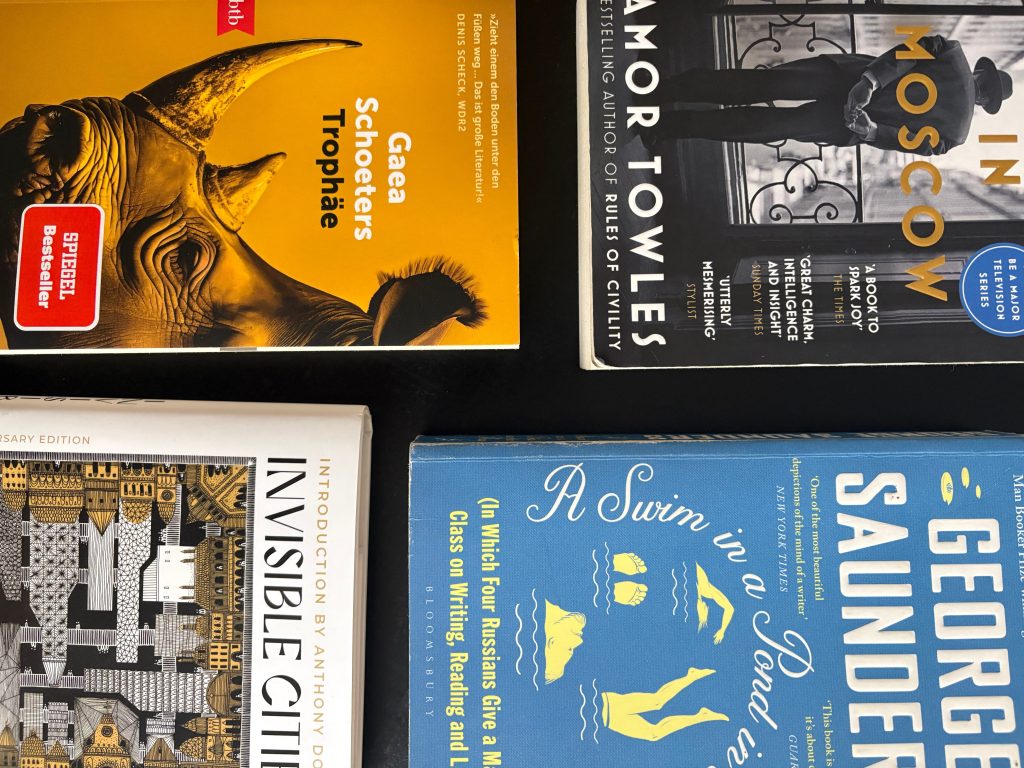
A Gentleman In Moscow – Amor Towles
This is a different type of Russian novel, mainly because it is not. The American author Amor Towles narrates the story of a Russian aristocrat who is forced into confinement at the Metropol Hotel in Moscow after the revolution.
This book is a very enjoyable read. One looks forward to spending time with the Count and the people he meets. Towles describes the scenes beautifully, in a way that one can imagine oneself being part of what is happening. It has a witty tone, and the story is heartwarming. This is a book that focuses on the good, which makes it such a nice book to read.
There are, in any case, two things I want to point out:
“If a man does not master his circumstances, then he is bound to be mastered by them.” The moral that the Duke repeats is not necessarily wrong, but it doesn’t land. Yes, he is being deprived of his freedom, but knowing what most of his contemporaries were going through at the time, his circumstances are not that bad. If the statement is made by Solzhenitsyn, it gains trustworthiness and becomes a central lesson of the book. But if it is made by a Duke who lives in one of the iconic hotels of the world, it is mainly an anecdotal philosophy he lives by. So, even if it is right and the Duke does well in believing it, it is also complicated to read further into it.
In the same tone, if depth is a spectrum, then this tends toward the ‘not deep’ side. Although not shallow, it is mostly good things happening. When something happens that is sad, we don’t get a memorable psychological exploration of how the affected deal with it.
That said, I never had the feeling this book pretends to be what it’s not. Both how the book is marketed and how it is written indicate that it is about immersing the reader in a pleasant story. Therein lie its strengths, and it is why I had such a good time reading it.
Because of its unapologetic compromise to be what it sets out to be, the reading experience, and the charismatic and warm characters, this has become a favorite on my list.
The Stranger – Albert Camus
I read this one in one go after buying it before a flight home. I got really involved in the story and couldn’t stop reading. The protagonist carried me away with his dispassionate internal dialogue and his detached way of being.
The book is not so much about a murder, but about how we’re very good at excluding people who don’t tick the same as most of us. In this case, it is an individual who seems cold, indifferent to what happens to him or other people. He lets himself drift and finds his place wherever he has to be. There is a lack of desire in him (except for the desire for women). He does not have ambitions, nor does he have wants. There are things he likes, but even once he is deprived of them, he seems to accept it quickly.
Meursault is a man who is not able to find any meaning in life, who sees no difference in dying now or in 30 years. What fascinates me most about this book is the personal view of an outsider: we see him as someone who is broken, who, in turn, feels there is nobody around who understands him. He is alone, denied the feeling of what most people feel, and denied the possibility of being understood.
This plays into Camus’ Absurdism. The protagonist is completely surrendered to the randomness of the universe. He does not seek meaning in God, he does not hope, he doesn’t judge morals: he just observes and accepts what happens. He observes and accepts both the consequences of his actions and what he can’t control, without illusions.
The main question that stays with me is: given that Meursault’s absurdism seems to be something he always carried with him (as opposed to a philosophy he willingly learned to live by), can we really become like him?
Invisible Cities – Italo Calvino
This is a different book. It’s a recollection of short descriptions of imaginary cities. Some cities could be real; others have magical properties. Reading about the cities felt like little bits of travelling. I would stop and imagine the cities, the people, and what was happening. Regardless of how one chooses to define it, the book is a great exercise in creativity.
I’m leaving the book thinking about Fedora, where you can see all the different Fedoras that could’ve been, but didn’t. Raissa, the unhappy city in which happiness is momentarily shared only between people and animals that are connected. Valdrada, which is perfectly reflected in water, and where everyone lives seeing their own reflection at every moment.
This book is about states of the mind. It is about the different things we value and how we try to find meaning. It is also about Venice. But for me, that wasn’t the point of the book. I think Calvino just wants us to escape reality for a bit and imagine together with him.
For me, this is one of those books that you don’t finish. It asks to be read again and again. And I’m looking forward to my next read of Invisible Cities. I’m sure that it will give me other, new things to take away. Until I see you again, Zirma.
Trophae – Gaea Shoeters
The streak of good books my grandma gifts me continues. First, let me start by complimenting the writing. Shoeters combines very descriptive language with playful and varying lengths of sentences to evoke in the reader not only the landscapes, animals, and people, but also to transport him into the states of mind of the characters and the rhythm of what’s happening.
The book is marketed as exploring the value of human life, but it is also a reflection on how circumstances change ethics. In this case, how colonialism affected Africa. That being said, the novel is able to not sound moralistic. What I most liked about this book is how Shoeters is able to paint a picture of a messed up situation, without blatantly stating her thoughts, something that I admire in Joan Didion, for example. In the end, the questions are laid open, and facts and perspectives are given, but the clash never happens between characters. It happens in the mind of the reader. And I believe that is the genius of this novel.
I hope the English and Spanish versions come out soon; I have some people that I want to read it.
A Swim In a Pond In The Rain – George Saunders
This was technically the only non-fiction book of the month, but it was still about fiction and stories. Saunders is an engineer turned literature professor, who created this crash course of short Russian stories in book format. Inspired by his classes but limited by the obvious constraints of a book, he is able to pack a lot of information and reflections into the book.
The structure is relatively simple: we get to read a story from Chekhov, Turgenev, Tolstoy, and Gogol, which are followed by one or two essays analyzing either the story and author, or some broader concepts or rules of thumb when it comes to writing.
I personally really liked the fact that I had someone walk me through the stories, letting me know how he understands and analyzes them. Saunders opened my eyes more to what to look out for in stories and has also made me think of the possibility of writing fiction; not because I believe I would be good at it, just because he makes it seem fun. I like to have fun.
I will say that some essays at the end feel messy. Saunders has a lot to say, but at times it feels like he wants to do it all at once. He writes what I guess he sounds like giving a class. This, I generally like. But there are parts in which it makes it difficult to understand his point. I was left thinking, ‘what are you trying to tell me?’
What I did like, on the other hand, is his openness. Although he shows us how he reads the stories, what he likes, and how he writes, he is also very clear that the beauty of literature lies in the fact that we can all relate to it differently. He’s not forcing us; he is not arrogant: he just shares. I really liked that about him.
One idea I’m leaving with is that reading and writing are about connecting (or trying to connect). Our species has ways to pull each other apart, and the act of reading and writing is the act of trying to stay together, to understand, to share. Even if it is not necessarily what we set out to do when picking up a book, it is still a beautiful result that is worth holding on to.
All in all, this is a book I found very stimulating. I liked the stories (The Nose is my favorite one), and the analysis. I found the reflections interesting and the writer very charismatic. I’m now trying to find more books like this.
The last weeks of December came with a thirst for fiction that I have not had in a while. I don’t know where it comes from, but I am here for the ride.


 leo burghaus
Leave a comment