Getting triggered on the internet is as easy as it is ridiculous. Because I’ve been a victim of ragebait in the past, I’m now very happy that I’m out of most social media. The ones I still use are LinkedIn (professional necessity) and Substack, which I didn’t believe to be home to so much stupidity when I signed up.
In the last months, I have resisted the urge to express my disagreement with many posts, because I thought this would give them more importance than they have, and because I didn’t want to be judgmental. But lately I’ve recognized that so many of these things go unchallenged and unchecked, and now I think that it’s better to at least call things out. I won’t save humanity with this, but at least I’ll save my sanity by not eating up these things in silence.
I also think there are different types of judgment. So I want to hold up a mirror to judgmental people on a high horse they don’t deserve to be on. Today, exemplified by haters of reality TV. Not as a defense of reality TV, but as a defense of personal choice.
Because the truth is, a lot of public displays of criticism have less to do with the object itself and more with a need to show moral superiority through taste. It is a way of virtue signaling. But because public criticism is important, we need to think about which ones we want to encourage, and which ones we don’t.
Some days ago this post got on my page:
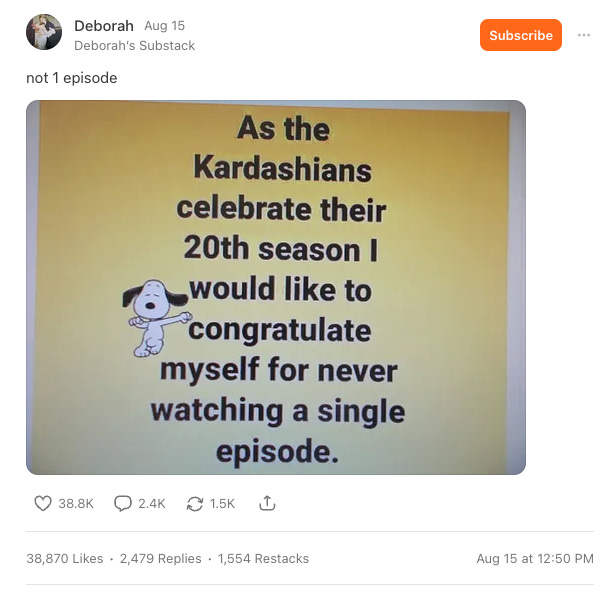
Now, usually, I wouldn’t give boomerslop much importance, but I saw 38.8k likes and 2.4k replies and got curious. I thought there would be some pushback in the comments, but after looking at a chunk of them, it seems like it is all reinforcement and mutual patting on the back for this incredible achievement… over two thousand functioning adults.
Now, criticism of the show is understandable. Watching a new-rich family manufacturing drama for entertainment and marketing is not the most productive thing you can do with your time. There are legitimate criticisms about the family promoting fast fashion, unrealistic beauty standards for teenagers, overconsumption, and toxic relationships. It’s the equivalent of fast food for the TV industry. And I think it is good to talk about the problems the show, or any other important piece of media, has. It becomes especially indispensable when it is mass-consumed, and often mindlessly.
But that’s not what the people are doing. They hide behind justified criticism of the show, but with the goal of perpetuating a false sense of superiority, based on shallowness. It reinforces the notion that certain things make you a worthier person than others, and it reinforces making judgments about other people based on what they do.
The irony is seeing how many people think better of themselves for not watching it, seemingly forgetting that they themselves are spending time doing things that they ideally shouldn’t. They are themselves scrolling on the internet, commenting without adding anything to the conversation, judging other people. The profile that posted this text is a distributor of internet content: some restacks of animal videos, patriotic posts, some male sexualizing, and a lot of pictures of her computer screen showing ‘memes.’
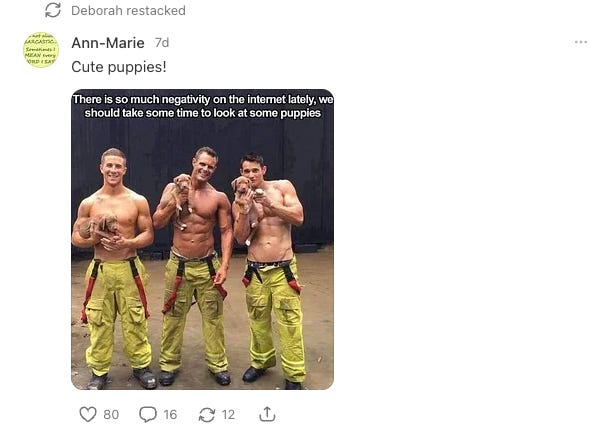
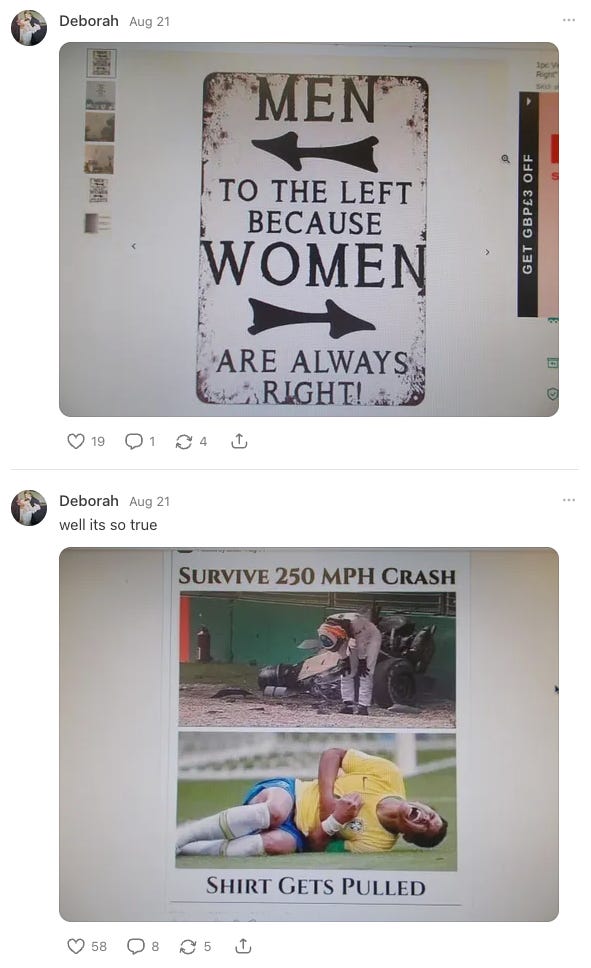

Look, I’m not shaming Deborah here. There is entertaining content on her page, and just because it isn’t my humor doesn’t mean I think she should stop posting. She has found people that like her things, follow her, and engage with her. That’s great, and I enjoy seeing people having found their place. And I like that there are sites like this that I can go to from time to time to be entertained.
But this is not highly intellectual content. It is not life-saving stuff. You’d be better off going for a 1-hour walk in the forest. It’s like me watching football. Or someone doomscrolling the NYT. Or bingeing prestige, high-quality TV like Brooklyn Nine-Nine.
And that’s exactly the point. We’re not perfect. We do weird things when we get freedom to do what we want. Most of us aren’t as smart or productive as we’d like, and often choose things that hurt us more than they help. Our current version is usually not what we think it could be. We’re chasing ideals. But isn’t that universal? Why are we shaming this? What good does pretending there’s a hierarchy of wrongdoings do? It’s like I would celebrate never having smoked from a vape whilst lighting my seventh cigarette of the day.
We don’t notice how hypocritical it is to rank behaviors because we’re oblivious to our own shortcomings. Or we’ve justified them for so long that they become rational. But they are not any more rational than other behaviors in other people. To stay with our example today, most people are incredibly oblivious to how much the digital world has consumed them. And that’s more dangerous than occasional consumption.
Because, in the end, it doesn’t matter so much what you consume, but how you consume it. Virtue is in the balance. You can read Nietzsche whilst daydreaming and not understanding anything, or you could watch the Kardashians analyzing pop culture and understanding teenage trends better. The Kardashians you might not like, but for many years they were a very relevant cultural phenomenon – and maybe that’s interesting to you. Or maybe it isn’t, and that’s great. You can spend 4 hours scrolling on Substack before going to bed after a long day of pretend-working, or you can squeeze in 20 minutes of the Kardashians between coming home from your day serving people and taking your dog for a walk or picking up the kids from school.
Your tastes are different, not better. You don’t have to watch the Kardashians. Nor does everyone have to read Dostoyevsky. In the end, you can only judge yourself: you might find that it’s more beneficial for you not to watch the Kardashians. But others might decide it is worth their time, and that this is how they want to spend it. Why shame them? What’s this obsession with showing smartness and perfection the whole time?
Everyone is taking themselves and their tastes way too seriously. Have some fun. If you want to read some cheap romance literature, that’s fine. If you’re curious about reality TV, watch some episodes and see what it’s about. If you like some Justin Bieber songs, don’t sweat it. If there is a donut-burger you want to try, do it. Our world has so much weird stuff to offer — don’t think you’re better because of the weird things you choose to do instead of the weird things others choose to do.
All in all, I just don’t like the attitude. Not because I feel offended (I watch a lot of football, and I’m used to people thinking they are better for not liking it), but because it shows how many people still look down on others based on the hobbies people have, or the ways they spend their time. This is something mature people shouldn’t take part in. Especially with people whose lives we don’t know. Life is not so much about what you consume, but about what you do with it. If you think you’re better at life than others for not watching the Kardashians, you missed the point.
About Judgment
And look, I am aware that I am myself judging. In fact, this whole article is judgmental. I am ranking actions on a scale from better to worse. And the fact that I’m acknowledging it does not make it better.
But the truth is, it is inevitable to judge, to classify, to criticize. If nothing is judged, nothing improves. But that doesn’t mean anything goes, either. The difference is between judging people and judging actions or topics. The only way to judge right is to analyze something and explain what is wrong or right about it. But performatively judging people because of some behavior is just an exercise in attempting moral superiority.
Alcoholism, for example, is undesirable. It’s bad, dangerous, and sad. But we’d be wrong to publicly congratulate ourselves for never having had a sip of alcohol, or for never having had an addiction.
We are who we are because of millions of circumstances, and feeling superior to others because of their circumstances is a sign of ego. I do think everyone has a lot of space for responsibility to make the best out of their circumstances. But precisely because nobody has made exactly the best of what they got, nobody is in any condition to look down on others. Actually, if you look at people we admire, they are usually the least judgmental people out there.




 leo burghaus
Leave a comment