I know, you’re here to read about smart, cultured topics. You don’t have a beer belly, aggression problems, or alopecia. You’re over this.
But if you are curious about why 5 billion people watch Football every year, and what’s happening on the top level, let me take you on a trip.
What is behind it?
Most of us fall in love as children. We play it in school and outside of it, we watch it on TV, and our parents bring us to the stadium. We see the big fan bases and hear the chants. We begin to have a favorite club. They give us a reason to cheer, to celebrate. We start liking players: either because we identify with them, or because we love the impact they have on the pitch. Usually, it’s a combination of both. We celebrate titles, or won relegation battles, or wins against the big teams.
When we grow, we see it is a fun way to unite with others. It sparks vivid conversations and gives a space to connect with new people you meet. It creates an environment in which disagreement is welcome and safe – the divide is never deep because we (most of us) understand the triviality of it.
Globally, millions speak its language. It has the power to bring countries together, in two different ways: either by uniting people from one country (national tournaments like the World Cup are events followed by many that don’t typically watch the sport) or by bringing people from one country in touch with the culture of others. We travel and see fans of our team on the other side of the world. Or we discover fan bases of teams we didn’t know. So many speak the language of football, which often is enough to connect with another person.
As with everything, it’s not so much the sport itself, but the emotion behind it. And I think football is such an established sport that it’s one of the few in which it is socially permitted to let your primal self out.
What I enjoy about it
Many things. The most obvious is the thrill of the game, or even the season. I have 2 favorite teams, but many I sympathize with. This gives me a reason to root for something. But I also like the leagues themselves, the competitions. Each year there will be new team or player revelations that will mix things up and give us a motive to watch.
But what grapples me the most can only be explained by it being like a TV show. The topic of the show is, for many, incredibly gripping: talented professionals at the highest level of their craft, going head-to-head against others. Each with their own sets of aspirations, challenges, potentials, and emotions. And the best thing: there is a new season every year, with new characters, new plots, and new dynamics. It’s an incredible product if you look at it from a show business perspective.
To illustrate this, and in a very simplified way, I’m using the Spanish league table from February:
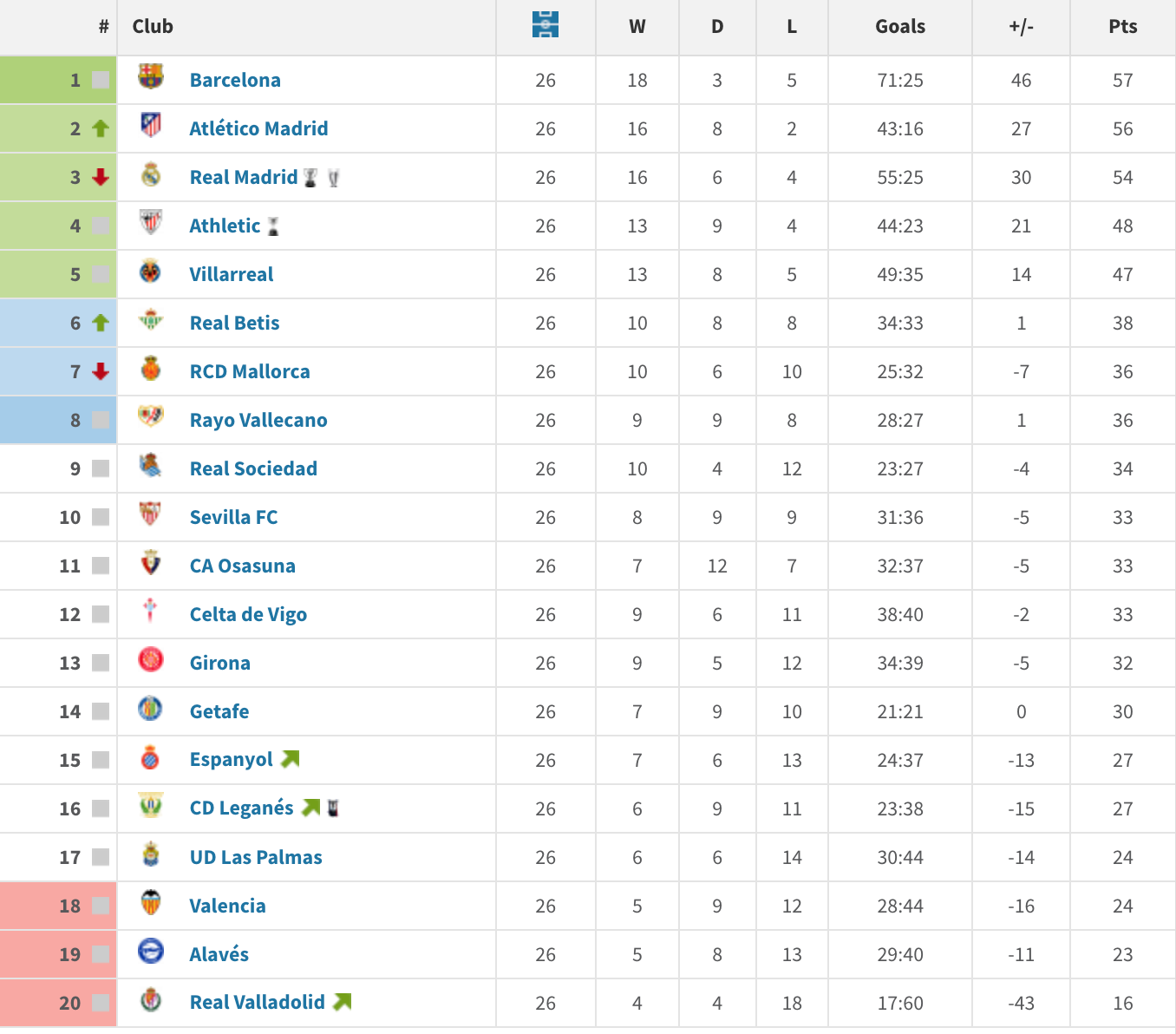
So, looking at the table, halfway through the season, the league looked like this:
- The top 3 teams were fighting for the league title, all within 3 points of each other. Effectively, that means that every matchday the order of qualification can change, as a win adds 3 points to your total, a draw 1, and a loss adds nothing.
- The first 4 at the end of the season go on to play in the most prestigious international club tournament (Champions League) the following year. There are two runner-ups for that spot, 1 point away from each other.
- Positions 5-9 also fight for a spot in European football next year (Europa League and Conference League). There are 8 teams all within the space of 6 points between one another – fighting for 4 spots.
- The 3 last teams get relegated to the second league. At this point of the season, only Valladolid seemed sure to go down. In a 4-point radius, there are 5 teams fighting not to end in spots 18 and 19. Relegation is a nightmare. Not only the relegation itself, but the year-long fight and tension to try to avoid it – with 3 sure losers at the end of the season. It’s not a situation you want to be in, as fan and less so as a player.
But this is just the competition. Yes, the stakes are high for every team: they all have things to fight for. But what makes it really interesting is that each team comes with its own stories.
- After a decade of disappointment, Barcelona was back playing top-class football, fueled by their youth academy players and a new coach. This stands in contrast with their eternal rivals Madrid, who after dominating Spanish and European football for the last few years and buying the world’s most expensive player in the summer, were not able to stand up to their competition.
- 3 clubs that in the last decade were in lower Spanish divisions (Betis, Real Mallorca, Rayo Vallecano) are suddenly some of the top contenders for European football.
- Girona, after an amazing season last year, is struggling to stay competitive after having lost some of their best players this season.
- Valencia, a legendary club in the Spanish league, is fighting relegation and in a deep crisis.
And each team comes with their players:
- 17-year-olds playing on the big stage like it’s their homeground.
- Players who were thought of as basically retired making us fall in love with them again.
- Redemption arcs of players mocked by the internet.
- Superstars not being able to deal with the pressure.
- High-tension situations which make usually average players play world-class.
- Disappointing games from players of whom more is expected.
The drama is always served, the pressure is always on, the stakes are always high.
The game is back
I love this game, but it had lost its magic recently. Partly, because the teams I don’t like dominated world football. But I think that, to some degree, the feeling was general. Football had become too overanalyzed. Too perfected. Too structured. Too predictable.
But this season had something different. Teams like PSG and Barcelona had a chaotic but very effective way of playing football. Inter reinvented Italian catenaccio. Madrid got beaten in the Champions League by Arsenal with free-kick goals. The Manchester City machine imploded.
There has been real emotion: old rivalries have been reignited, new ones have come up. We’ve probably had more Champions League games that will go down as classics this season than in any other of the last 15 years. I’m thinking of the Liverpool-PSG’s, the Madrid-Arsenal’s, the Inter-Barcelona’s.
Of course, some fans will be disappointed. But I think there is a general feeling among football fans: in a game that had lost its spark and emotion, we have had a year that reminded us of why we fell in love with this sport in the first place. The surprises, the thrillers, the underdog stories, and fights at the highest level.
Football is back, and I hope it is here to stay.




 leo burghaus
Leave a comment