If you didn’t grow up with reggaeton, you might be oblivious to its magic. In Spanish-speaking countries, reggaeton is the music of choice for parties, individual playlists, road trips, friends’ gatherings, and even background music. Not everyone is a fan of it, and other styles like electronic music or hip-hop have a solid fanbase, but nonetheless, reggaeton has been a backbone of culture for the last 20 years.
What is key to both the genre and what I’m about to tell you is to know that it is by nature a combination of different styles. It originated in Latin America in the 1980s as a mix between Jamaican dancehall, Spanish reggae, hip-hop, and Latin American music. It took time to develop, but once it reached Puerto Rico, it couldn’t be stopped. You’ll probably know Daddy Yankee from “Gasolina” (2004) or “Despacito” (2017). Still active today, he is widely considered the figure responsible for popularizing the genre and bringing it to the big scene. Other legends include Don Omar, Tego Calderón, Ivy Queen, and DJ Playero (whose mixtapes were crucial).
Reggaeton grew massively, and made urban Latin music so popular it makes up around a quarter of global streaming charts nowadays. In the US alone, it grew to be a billion-dollar industry since 2022. As you can imagine, both styles evolved and new artists emerged. Every year there seems to be some new, wildly popular artist dominating the scene. Even with its competition and feuds, it seems like there has always been a lot of cooperation between artists: most hit songs have artistfeatures, sometimes even 6 or 7.1 Artists in reggaeton seem to understand that as a whole they are bigger than each artist individually.
But there is one person dominating the scene: Bad Bunny. He’s the starboy of reggaeton, and because of his trajectory, on a different level than any other artist in the field. His tours alone make him more than $100M in revenue. He is also the embodiment of where the scene is probably going if it wants to stay relevant, but more about that shortly.
Anyways, enough history.
Reggaeton has a problem. It stagnated. Feid and Quevedo were probably the last artists bringing something new to a genre that was starting to sound more and more the same. The drums and beat of reggaeton will always be the core of it, but after many years, the ideas of how to use them seemed to be running out. It could be that producers got so established that innovation was difficult to get through, that consumers just got used to the typical styles, or that the growth of new consumers in non-Latin countries masked its flaws. Or a combination of everything. Or other factors I haven’t thought of.
But it has been difficult to popularize new ways of understanding reggaeton, and there has been little innovation. If I think of 2 of the biggest Spanish stars from the last years, Rosalía and C. Tangana, they had the ability to use older, more forgotten styles (especially flamenco), to mix up the scene coming up. The refreshing music was what made them popular in the first place, but they have moved away from the genre in generalt lately, each pursuing their own creativity.
But here enters the king. Bad Bunny started the year by bringing out a new album, and I think that after well over a month, it’s safe to say it has landed. There’s an argument that any album of his would be a hit, but that’s not true. His last album, “Nadie Sabe Lo Que Va a Pasar Mañana,” was, for Bad Bunny standards, a flop. Especially considering his previous album “Un Verano Sin Ti” is by far his biggest hit.
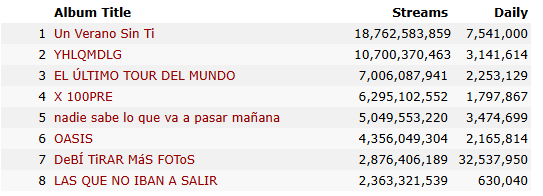
This album will probably surpass most others over the years, and I believe some of the songs will become classics. It took social media by storm (the songs “NUEVAYoL,” “BAILE INoLVIDABLE,” and “DtMF” all having their own trends on TikTok & Instagram2), and the numbers show the songs being very well received by the public.
So, what’s new?
The key to the success: He used more styles and genres. All of the best-performing songs have elements of other currents in them. “BAILE INoLVIDABLE” is more salsa than anything. “NUEVAYoL”‘s most famous part is a sample from an old Puerto Rican song, but it also has salsa elements to it. “DtMF” also has salsa, but most importantly, the Puerto Rican folk genre plena (one of the oldest genres worldwide) – and the most famous part of the song is a chorus that has very little to do with reggaeton. He also played around with house music and jíbaro.
Bad Bunny explains that he wants to reinvigorate his culture and these traditional styles. He’s using his platform to give visibility to other genres.
But I think he also recognized that reggaeton needs to evolve, and he went back to the basics: using other genres to take inspiration from. And it’s a current you can see all over the Latin music scene.
At the time of writing, the top song in Spanish charts is “Capaz (Merengeton).” The name already has the message in it that this is a mix of merengue and reggaeton, and it’s the best example of what artists are doing:
- They are using rhythms from other genres, like salsa, bachata, or in this case, merengue.
- They are using samples from older songs or classics.
The top 15 charts feature 2 more songs from the same merengueton album, 5 songs from the Bad Bunny album, “Degenere” from Mike Towers, which is a sample from “Tom’s Diner”, songs from Obi on the Drums who’s famous for combining different musical styles, and only 2-3 songs which we could consider traditional reggaeton.
And the truth is: it’s refreshing, and at least from my opinion, the output has been way better in the last months than in the previous 2 years. I noticed that many of the songs I’ve been saving on my lists had recycled elements of both styles and rhythms.
There is another industry where this is happening, but not very successfully for the time being: Hollywood. “Every single one of the top ten box office hits of 2024 was a sequel, a remake… or a prequel.” Something is up.
In any case, let’s wrap this up.
This is nothing new. Music always evolves and mixes with currents. The whole genre of reggaeton is based on this, so it’s no surprise that in times of crisis the way out is probably through going back to the mixing table. But I still believe it’s a noteworthy time in place, and we might see some interesting combinations in the future.
There will be a part of artists who won’t change much, because there is still a market for that. But a new wave of reggaeton is coming, and I’m in for it: Urban Latin spice has made many things better. Let’s see what music genres are next. Who knows if we will see Bad Bunny venturing into Country Music, sampling “Sweet Home Alabama”.
- 7 is not a random number. The second-most streamed song in Spain (Cayó La Noche) in 2022 had 7 singers on it, for a 7 minute song. ↩︎
- It’s important to notice, social media plays a tremendous role in the music industry. Artists have a chance to popularize a song by having a memorable and different 20-30 seconds fragment in there that will be used in trends. Bad Bunny knew what he was doing with these songs, and it probably played a part in his strategy to have elements of his album being tiktokable.
↩︎

 leo burghaus
Leave a comment